Posts tonen met het label TU Delft. Alle posts tonen

donderdag 17 maart 2016

Revision of two scanning methods, by Kotryna Valečkaitė

As promised, we would give the summarized results for the two scanning sessions that we had: with CT scanners and with Artec Spider scanner.

Part of the results of the latter unexpectedly disappeared during the post-processing. The scan which promised the most for us, Hermione handle detail, was among the missing files. We hoped to get better results of the floral ornament and combine it with the CT-scan body, only the chosen comparison model and Harry survived.
Kam artec spider
As seen, for the comparison we chose the finest model we had. The lice-comb teeth were approximately 0.5 mm diameter with even smaller gaps between them. Due to this, the scanning technique used by Artec Spider could never achieve a proper result: too much was not visible, even with the precision of 0,05 mm. In other words, the grid which the range finding device projected could not be interpreted in the gaps and the result was a block with a texture instead of a comb. Moreover, looking at he scan of Harry we can see a big inconvenience for us: only the outer surface and the sections at the breaks were captured. Moreover, the cracked surface texture was not captured, because we got the file only in a mesh file.
artec scanner harry
Therefore, it would be expected that this problem would not be so apparent in CT-scans. This technique captures the sections of the object, instead of making an interpretation of surface. Just then these sections are interpreted into 3D files. However, the precision of 0,3 mm proved to be insufficient for the artifact we chose:
macro CT kam
As seen, the result was a more consistent file, which could actually be printed. Nevertheless, it was far from what we would call sufficient. Expecting this, we also made micro-CT scans of the object. The sneak-peaks of the object in the lab itself looked very promising. Yet our and publicly available computers could not handle the size of the data set (over 2000 sections!) and could only give results in the lowest resolution, leaving us with the following model:
micro kam
As seen in the picture, the separate teeth are clearly visible, although the main body is missing. This can be easily solved if the used computer has 16GB RAM, since we could get a proper model in Avizo a few moments before it crashed due to memory insufficiency.
To conclude, only the micro-CT scanner offered the sufficient results for the compared artifact. The Artec Spider is very interesting if surface detailing in necessary or if textures/colors have to be captured. However, if not enough scans are made and combined, you will get an object lacking details, thus resulting in incredible amount of work hours in post-processing. Another solution for this would be to make CT-scans and combine them with the Artec Spider scans only for the details.

Plaster prints, structural solutions and CNC-milling, by Kotryna Valečkaitė

This week we focused on production techniques, yet not all of them proved to be possible to produce. In the background we also finished up processing all of the CT scans, of which an overview article will follow next week.

To begin with, we made multiple 3D prints: plaster prints of all of the loose pieces and a tryout of structural solutions in Ultimaker2. The first one we decided to translate into a game during the science fair, while the second one was primarily made for the mid-project presentation. Moreover, we made a form with a CNC milling machine which was later used for vacuum forming. This proved to be the cheapest, easiest and the most user friendly object so far.
Plaster print
DSC_0380
Structural solution
DSC_0376 DSC_0375
CNC milling and vacuum forming
DSC_0377 DSC_0378 DSC_0379
Secondly, we discarded paper printing as a possibility due to two main reasons:
  1. Our files were too large to be opened in multiple programs with which we could have given the surfaces color;
  2. The delivery times were too long
This led us to choosing another form which would work the best in the Connex printer. Yet that would lead to rather large expenses, exceeding 100 euros per object. What is more, using soft materials would mean that we strive more for a visual than a functional prototype, since the objects could not withstand warm drinks or even a dishwasher. However, some of this could also be achieved by simply printing the different materials apart in the Ultimaker2. Simply put, we are still struggling to determine what fidelity level we are looking for and what each prototype can achieve. Moreover, instead of having a single idea to work out we actually multiple interpretations of the same object:
  1. Cheap, everyday object (vacuum form)
  2. Object focusing on the aesthetics of historical footprint/3D printing (Connex prints/plastic injection molding)
  3. A game, interactive cup (plaster print of shards)
In other words, it means that the objects form their own trajectories and cannot be easily compared with each other.
To conclude, we now have to focus on what precisely we want to achieve in these trajectories and how to do it using rapid prototyping techniques. That is not what we planned during the first week, but that will lead to more evenly divided workflow and, hopefully, more interesting results.

dinsdag 15 maart 2016

Processing scans into 3D models (take 2), Kotryna Valečkaitė

As promised a day ago we would keep you posted about our adventures with image processing software. Even though we did not receive the trial version of Mimics, Avizo provided a very pleasing outcome and it also read .dcm files.
The program itself is very user friendly and incorporates visual programming with automatized properties, thus giving  the user just enough freedom to not crash his computer or make the process incomprehensible. In this sense it is very similar to 3Dslicer, yet Avizo has more options and more finesse in the details.
The final result is not yet perfect due to rather clear “stepping” in the final 3D model. This, according to our “informer” from the Industrial design engineering faculty, could be solved with Geomagic. However, now we can clearly state that the plan A mentioned in this post is actually possible.
Interface Avizo Hagrid
Avizo interface
Hagrid in rhino via Avizo
Detail in Rhino

vrijdag 18 december 2015

Minor Advanced Prototyping: lets get started!

Welcome to the logbook of the research project Augmenting Prototypes: Smart Replicas. This project is a part of half year bachelor program “Advanced prototyping” in TU Delft.
Smart Replicas is the result of a collaboration between Archaeological department Amsterdam and design studio Maaike Roozenburg. The latter supervises 4 students preparing material for this blog: Kotryna Val (Architecture), Sander Pliakis (Industrial Design), Jorinde Smitser (Industrial Design), Irene(Industrial Design).
The focus of the project is the usage of CT scans to recreate and analyse repaired and/or unusable archaeological findings of everyday use.The aim of this is to replicate and improve given objects, while not losing the historical footprint. In other words, the blog will revolve on modern techniques of digital and physical reproduction.
The simplified planning will follow the scheme provided below. Each set of steps will be described in a weekly report, which will complimented with an occasional review of the field.

https://smartreplica2015.weblog.tudelft.nl/files/2015/09/Project-Approach.png

dinsdag 24 november 2015

maandag 26 oktober 2015

Uitnodiging: Science Fair TU Delft

Het maken en breken van alledaagse gebruiksvoorwerpen is van alle tijden. Omdat vroeger de waarde van deze objecten hoger was dan die van arbeid, werden ze meestal gerepareerd. In dit project worden alledaagse gebruiksvoorwerpen uit het verleden met behulp van CT-scanners in kaart gebracht, om vervolgens een 3D-reconstructie te maken. Hierdoor kunnen we erfgoed weer tot leven brengen als gebruiksgoederen in de huidige tijd. Dit project is een ontmoeting van ontwerp met technologie en erfgoed door een samenwerking met het Bureau Monumenten en Archeologie Amsterdam en Studio Maaike Roozenburg.

http://smartreplica2015.weblog.tudelft.nl

Tentoonstelling minor Advanced Prototyping
Dinsdag 27 oktober 2015, 12:30-15:00 uur
De afsluitende lezing van Nadya Peek begint om 15:15 uur
Locatie: "De tribune", Centrale hal, Faculteit Industrieel Ontwerpen, TU Delft
Landbergstraat 15, 2628 CE Delft


maandag 27 oktober 2014

Reconstructing the past take two: Herengracht 476

The next challenge was to use the Structure Sensor to capture a 17th century house on the 'Gouden Bocht' (Golden Bend) in Amsterdam. This two parcel wide majestic residence of the then Mayor of Amsterdam was the home where the porcelain teacup, we follow was used. The building is now used by the Prins Bernard Cultuurfonds.
The team (Audrey Loef (Architecture), Rosan Foppen (industrial Design), Ingmar Klappe (Architecture) and Senna Meij (Industrial Design) of the Technical University Delft, needed to use all their resourcefulness to get the job done. Despite of the 'promise' the Structure Sensor proved to have extreme difficulties with reflective surfaces, such as windows and glass, high ceilings and strong light/dark contrast.
The result: the beautiful ‘salon’ changed into a more ‘cave-like’ space. Clearly the Structure Sensor wasn’t up to the task of scanning a historical abundantly decorated sitting-room! 
Herengracht 476, Huize de Vicq

Salon, huize de Vicq


Salon, huize de Vicq

3D scan by the Structure Sensor

dinsdag 21 oktober 2014

reconstructing the past take one: a 17th century plate

Last week Audrey Loef (Architecture), Rosan Foppen (industrial Design), Ingmar Klappe (Architecture) and Senna Meij (Industrial Design) of the Technical University Delft have been working on a project for the Minor Augmenting Prototypes. They have tested a new 3D scanning device the 'structure sensor' for its use in reconstructing historical objects. This week the object was a porcelain plate, made in the 17th century in Japan, ordered by the then Mayor of Amsterdam. The plate is part of a set of tableware that was (likely) ordered for the marriage of the mayor with Aletta Pancras that took place at august 30, 1667. This plate is part of the collection of the Amsterdam Museum, and we are greatful that we had the oppertunity to scan the object in their depot.
Other (known) part of the set of tableware are two cup-an-saucers at Museum Boijmans Van Beuningen, a plate at the Victoria&Albert in Londen and a plate at the Idemitsu Museum in Japan.
Hre you can see the plate and the 3D computer reconstruction after the scan.

17th century plate, collection Amsterdam Museum, foto Senna Meij

3D scan of Structure sensor

3D computer model, modeled after scan, bottom view

3D computer model, modeled after scan, top view (excluding decoration)

maandag 13 oktober 2014

Students Technical University Delft test 3D Structure Sensor

Last week the Minor Augmenting Prototypes at The technical University Delft took of.
Audrey Loef (Architecture), Rosan Foppen (industrial Design), Ingmar Klappe (Architecture) and Senna Meij (Industrial Design) did take up the challange to make a 3D model of a 17th century teatable at Museum Boijmans Van Beuningen, using the just developed Structure sensor. Their project can be followed at their blog
The reconstruction of this table will be part of the content of the prototype of the Smart Replicas of the 17th century Japanse teacup.


woensdag 9 juli 2014

LikeFriends is looking for a motion gfx / ux designer

We’re excited to be working with Studio Maaike Roozenburg in bringing SmartReplica’s to life. (www.maaikeroozenburg.nl or http://smartreplicas.blogspot.nl/). As per direct (this september at the very latest) we’re looking to bring to the team a talented motion graphics designer / 3D animator. If you’re a great C4D modeler and animator, and you have a natural interest in UX, gaming and technology, you’ll love working on this project.

You’ll be working closely with our creative directors and developers in creating the AR interface and 3D content for the project. This will be an iterative process; you need to be able to quickly generate and try out new ideas, and be able to tolerate throwing most of them out. We’re looking to develop various interactive scenes that the user can play, explore, and dig into, using their physical phone as the main means of navigation. So the way we tell our story is more game-like than film-like. Your lighting and rendering skills are of less importance in this than your modelling, animating, technical and creative skills.
At the end of the project we hope to ship a fully functional prototype. If we’re succesful this prototype will become the basis for a series of museum exhibits as well as a range of consumer facing products.

If that sounds like your cup of tea, shoot an email to jasper@likefriends.nl. We look forward to having you on the team!

donderdag 15 mei 2014

Smart replicas is teaming up with LikeFriends!


Studio Maaike Roozenburg is pleased and honoured to announce a new partner joining the
Smart Replicas team: creative agency LikeFriends. Their expertise in bringing digital
content to life will be of significant importance in making replicas truly ‘smart’. Creative
Director Jasper Mittelmeijer: “We love this idea of using technology to turn the museum
inside-out: making historical objects and their stories break through the museum walls and
back into everyday life.”


LikeFriends will strengthen the interdisciplinary team of Studio Maaike Roozenburg,
Museum Boijmans Van Beuningen, Delfts Technical University and the AR(Lab) of the Royal
Academy of Arts. With the addition of LikeFriends we’re bridging the gap between
museological heritage and science and the commercial creative industry.


The team at LikeFriends will focus on information architecture and interface design for the
new prototype we’re creating. This prototype will consist of a fully AR powered Smart
replica of a beautiful 17th century teacup, ordered from Japan by the then mayor of
Amsterdam. A magnificent example of Asian-European trade, packed with stories of
mystical Japanse porcelain, sea voyages and extravagant tea parties.
If you’d like to get involved or want to follow the process of examining and constructing
this new Smart replica please check:

http://www.likefriends.nl/blog/LikeFriends

maandag 13 mei 2013

Smart Replicas at MuseumNext Fringe Symposium

-->
Smart Replicas: bringing heritage back to life
an introduction (in English!)
for more information look at www.maaikeroozenburg.nl

treasuries of objects

Our museological heritage is a collection of objects that has been collected, categorized, grown and preserved over the course of centuries; objects which we value for their historical, cultural and social context; objects that play a key role in the image of our history and our identity. Our history is examined, reconstructed and visualized through these objects. But how do we relate to all these stored items? What is the relevance of these objects for us at this time? And what is their significance in a rapidly digitizing society?

Museums and cultural heritage sites are the “institutions” who manage this heritage; storehouses of objects, stories, images and historical knowledge. The conservative way these objects are made accessible you must to go to a museum or exhibition — means you can admire, but not touch, let alone use them. This strips the objects of their main purpose and function — their original use — and isolates them from our daily lives.

‘Enriching’ objects

The knowledge and information that museums and cultural heritage sites hold, collect and develop concerning the items they own and manage is barely accessible. It is fixed within the confines of the museum and is often reduced to a short text on a museum plaque or an item in a catalogue; the objects and information that the museum has is thus hardly accessible to the public.
In the project Smart replicas, we investigate how 3D prototyping — technologies such as 3D scanning, printing and reproductions which make digital objects “real” and vice-versa — and Augmented Reality (AR) can contribute to the accessibility of these museum objects while also increasing our knowledge of the objects. How can you “reverse engineer” a museum piece? Will this allow us to take museum pieces out of the museum and put it to use again? Can you turn heritage into new design? How can you link these objects to the historical information that is stored in the museum? How would people interact with these “enriched” objects? These questions are being  examined within the project Smart Replicas.

Smart Replicas

'Smart replica' is a term we have given to replicas of historical objects made useable again by means of 3D scanning and printing techniques. 'smart' refers to 'intelligent'; these are not just copies, but replicas enriched with innovative technologies such as AR to carry of information, so that outside the museum they can serve their original intent and provide information at the same time. That way, heritage can provide new designs; objects shaped and refined through the centuries can be used in the present. Smart Replicas is a project by Studio Maaike Roozenburg in cooperation with  4 partners: Delft University of Technology, Faculty of Industrial Design and Faculty of Civil Engineering, Delft Heritage, Department of Archaeology, Museum Boijmans Van Beuningen, the AR Lab at the Royal Academy of Art in The Hague and students from Graphic Design of  Royal Academy. A team of very different parties with their own background and expertise contribute to this project: academics, students, curators and technical experts. Smart Replicas is a project in which the worlds of museological heritage, design, art history, 3D prototyping and AR comes together.

“Reverse engineering” historic items

Seven tea cups from the Boijmans Van Beuningen collection form the “base material” to explore how reverse engineering and 3D prototyping can be used to produce useful replicas of museum pieces. Previous tests have shown that a (medical) CT scanner can scan very vulnerable and “untouchable” historical objects. This does not damage the objects and meets the museum's guidelines for handling these objects. The resulting data can be converted to a digital reconstruction of the object that can be printed in a 3D printer. The aim is to combine 3D prototyping techniques with the historic porcelain techniques applied on the original cups. This includes experimenting with milling porcelain casting moulds straight from 3D models as well as printing porcelain directly. It is important that the replica is a complete designer product that invites everyday use and can lead a new life outside the museum walls.

“Smart” objects

AR brings the physical and digital worlds of an object together. This transforms it into an information medium. Or rather, AR can show the information, history, context and stories associated with the object. Each porcelain cup is a historical source, with a wealth of historical information: stories about traveling, locations, production processes, use and rituals. AR allows us to make this information visible and actually link it to the object; connecting knowledge to the object itself, outside the context of a museum. This allows the knowledge, carried by the replica, to leave the museum and enter the wide world.

A group of students from the Graphic Design department at the Royal Academy of Art is working on structuring and shaping digitized historical information concerning the cups. They can develop their own line or narrative and design it in a matching medium. Routes can be accessed with Google maps, moving images through animation and text with visual or audio stimuli. These designs will be linked to the replicas using AR. The research also includes the markers that create that link. Here we examine how to combine the historical techniques and decorations of the original museum pieces with technology aided by markers and object recognition
What is the real significance of our heritage?

With the project “Smart replicas”, we examine how 3D prototyping can be used to put heritage back to use and how AR can turn objects into information carriers outside the museum. The underlying questions we want to ask are: What is the meaning of all these stored historical objects? How do we relate to them? Are they relevant to us now? What happens when you copy them? What does this change in our perception and appreciation of the real object? What is the relevance of these objects in our increasingly digital society? Augmented Reality and 3D prototyping offer opportunities to pose these questions (indirectly), and to identify and investigate them.

The result is a trial installation in Museum Boijmans Van Beuningen, where the smart replica prototypes can be 'touched', used and tested by the public which will be open  in june 2013.

donderdag 14 februari 2013

Smart Replica's op Object: de eerste test op publiek!

Tijdens Object Rotterdam is van 5 t/m 10 februari de eerste 'kitchen review' van het project Smart Replica's gepresenteerd aan het publiek. Een druk bezochte beurs, die ons veel feedback en positieve reacties heeft opgeleverd. Daarnaast een artikel van Jeroen Junte in de Volkskrant en van Gabrielle Kennedy op Design.nl http://www.design.nl/item/smart_replicas

hierbij een impressie

micro prototyping by Mareco Prototyping


dinsdag 15 mei 2012

wat vooraf ging: loosdrechts porselein tot leven wekken, een experiment(4)

En dan tot slot, het koppelen van de porsleinen replica's aan gedigitaliseerd historisch materiaal. De eerste experimenten hebben de TU Delft studenten gepresenteerd op de Science Fair.

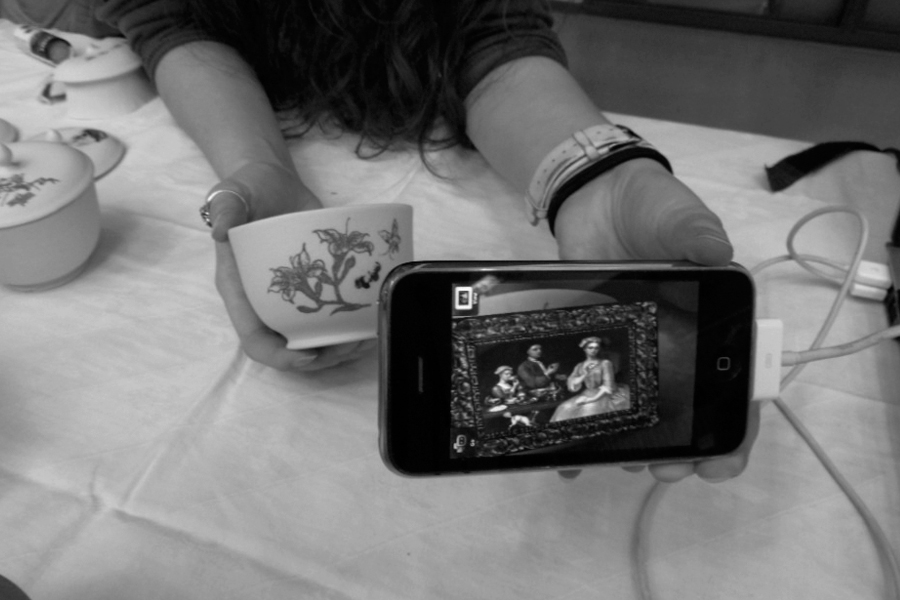
mobiele app van Junaio 'projecteert' 18e eeuwse decoratie op porseleinen replica
mobiele app van Junaio 'projecteert' schilderijen, prenten en muziek op porseleinen replica


testen met Junaio, een app waarbij een afbeelding als marker werkt
3D digitale reconstructie van de decoratie op het 18e eeuwse origineel

wat vooraf ging: Loosdrechts porselein tot leven wekken, een experiment(3)

Gedurende 5 weken hebben 4 studenten van de TU Delft, Industrial Design en Architecture gewerkt aan experimenten met markers in en op porselein en Augmented reality. Hieronder een kleine sellectie:
3D print van suikerpot voorzien van AR marker in relief
mal met gegoten porselein mer AR marker in de 'ziel'
porseleinen replica van suikerpot met AR marker
porseleinen replica van suikerpot met afbeelding als AR marker